Salsa Social Etiquette: How to Make a Dance Comfortable for Both People
A comfortable salsa social is built from small decisions: how you invite someone, how you respond when a movement does not work and whether you notice the people around you. You do not need an impressive repertoire to be considerate. Start with a simple aim for each song: make space for your partner’s choices as well as your own. Local customs can differ, so read the event’s conduct policy and ask the host when you are unsure.
Make the invitation easy to answer
Ask rather than taking someone’s hand and moving them onto the floor. A short invitation gives the other person room to respond. If you are new, you can say so without apologising: “Would you like to dance? I’m a beginner.” You can also mention the timing or style you know.
If the answer is no, acknowledge it and move on. There is no need to request an explanation or negotiate another song. Sydney Salsa’s conduct policy explicitly asks dancers to respect refusals and personal boundaries. Being friendly afterwards does not turn the refusal into a promise for later.
Agree on the dance you are actually having
Accepting one dance does not mean accepting every movement. If something feels uncomfortable, say what you need in plain words: “Smaller steps, please,” or “I’d rather skip turns.” You can pause or end the dance. If a partner is not comfortable continuing, stop without making them justify it.
As a practical default, leave dips, lifts and unfamiliar tricks out of a casual dance with a new partner. A video-worthy moment is not a shared plan. If you want to explore something more demanding, do that in an appropriate taught or agreed practice setting.
Share the floor rather than claiming it
Before starting, look for enough room for both people. Keep your steps compact when the floor is busy. If space disappears, simplify the dance instead of trying to complete the pattern anyway. A basic step or a pause can be a better choice than a travelling combination.
Keep drinks, bags and conversations off the active dancing area. Latin Street’s code of conduct emphasises collision awareness and venue rules, including keeping drinks and powders off its dance floors. Follow the rules of the room you are in rather than changing the floor surface yourself.
Handle mistakes without turning the song into a lesson
If a movement goes wrong, reset. You do not have to decide who caused it while the music is playing. Try something simpler, keep listening and let the next phrase be a fresh start. A smile can acknowledge a harmless mix-up without making it a performance.
Save technical corrections for a lesson or a practice session where feedback has been invited. Sydney Salsa also advises against unsolicited teaching. If someone asks a question, you can answer briefly, but you are allowed to say that a teacher would explain it better. The social floor is not an examination.
Be considerate between songs too
Arrive in clean clothes and take breaks when you want them. Keep a spare top if that makes the evening more comfortable. Thank your partner at the end, then let the dance finish without assuming another one. You can invite them again, and they can make a new choice.
Ask before filming, and check that anyone who would be recognisable is comfortable being included. If a boundary is ignored or you see concerning behaviour, speak to the organiser. You do not have to solve the situation alone or wait until the end of the event to raise it.
Start with one manageable evening
If the room feels unfamiliar, choose a small goal: introduce yourself to the host, dance one simple song or watch how people enter and leave the floor. Our beginner guide covers taking the first steps into a class and social. The salsa glossary can help when movement names come up in conversation.
The most useful etiquette habit is paying attention. Notice your partner’s response, the space available and your own comfort. A respectful evening can include many dances, a few dances or time spent simply listening.
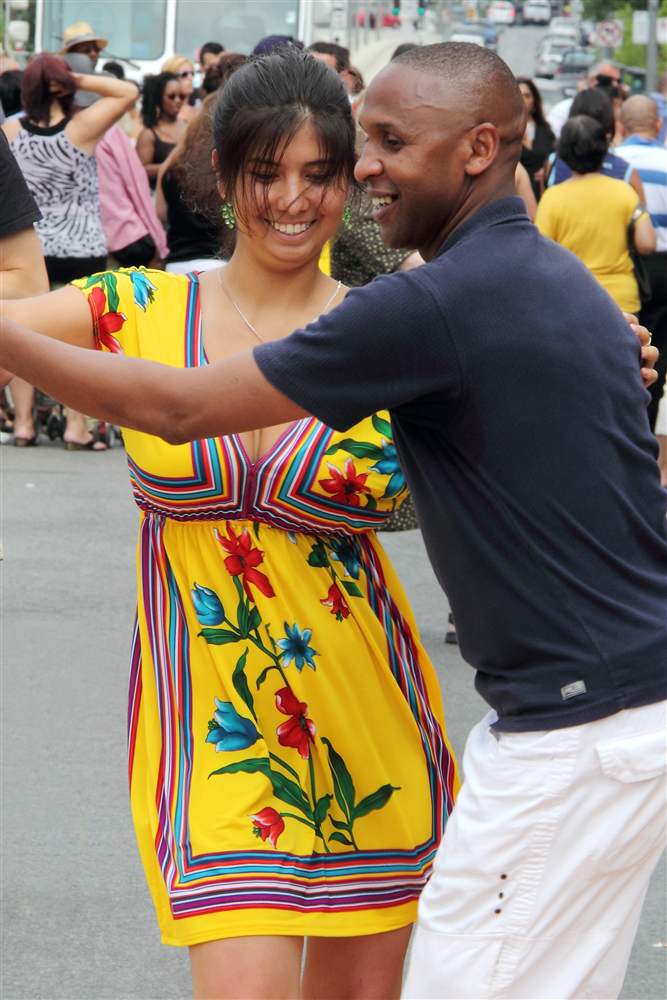
Photo: Ryan from Toronto, Canada / CC BY 2.0. A couple dancing at a salsa street social. Illustrative archive photograph; not a photograph of the current event or specific attraction discussed. Resized and JPEG-compressed.