Solo Salsa or Partner Practice: What to Work on in Each Session
A missing practice partner does not have to mean a missed week of salsa. Equally, being able to repeat a sequence alone does not tell you how it will feel with another person. Give solo work and partner practice different jobs. One can help you examine your own choices; the other lets you discover what happens when someone responds. A useful plan begins with the question you want to answer, rather than a target number of moves.
Use solo time for things you can observe yourself
You can listen to a class song, repeat familiar footwork and check whether you know which foot is carrying your weight. You can also practise recalling a movement name or noticing when a musical phrase changes. These tasks do not require you to simulate a partner with an imaginary arm.
The Dance Dojo’s teaching programme distinguishes solo subjects such as shines, body movement and musicality from partner-work material. That is a useful way to organise your own practice list. Choose a familiar task that you can repeat without guessing at an unfamiliar technique.
Try a short solo session with one question
Here is a simple practice structure you can adapt. Spend a few minutes listening to a song without stepping. Then repeat the basic your teacher has already shown you, slowly enough to notice each weight change. Finish by choosing one short piece of familiar footwork and returning to the basic afterwards.
Keep the question narrow: can you return to the basic without rushing? If the answer is unclear, simplify the footwork rather than adding another pattern. Stop when your attention has gone and write down what you want the teacher to check. The duration is your choice; the point is to make the task easy to remember.
Understand what a shine is doing
Shines are solo footwork, and they can appear within a dance that also includes partner work. Toronto Dance Salsa describes partners separating for their own footwork and then coming together again. You do not have to treat that moment as a solo audition. A familiar basic can be an appropriate choice while you listen.
In your own practice, make the return as important as the footwork. Leave space, keep noticing the other person and do not assume that they want an extended break from partnering. If you are unsure how the class handles that transition, ask the instructor to demonstrate it with a simple example.
Give partner practice a shared purpose
Before the music starts, agree on one exercise and how either person can pause it. For example, you might repeat a familiar transition and ask whether the invitation is clear. Avoid giving both people separate private goals that compete with each other. “Let’s try this once, then talk” is easier to follow than a whole list of corrections.
Take turns describing what you noticed. Prefer a specific observation, such as “I felt the hand change after I had already stepped,” to a verdict about who is good or bad at leading or following. If neither of you knows how to solve the issue, keep it as a question for a teacher. Repeating it faster is not an answer.
Leave teaching to the lesson
Practice is not permission to force a movement or move a partner’s body into position. Keep to material you have both agreed to work on and avoid using someone else as a test subject for a new online trick. If an exercise is not comfortable for either person, stop or change it.
You can also practise the process of restarting. Pause, find a comfortable shared position and begin the familiar basic again. A calm reset can be a more useful result than finishing a complicated sequence after the connection has become confusing.
Combine the two without overloading your week
After a class, choose one solo question and one partner question. Work on the solo question when convenient; bring the partner question to an agreed practice or your next lesson. You do not need a separate programme for every day, and you do not need to perform a full routine to show that the week counted.
Our getting-started page covers the broader route into classes and socials. The salsa glossary explains terms such as shines and cross-body lead. Use those resources to make your questions clearer, then let each practice session address one manageable piece of your dancing.
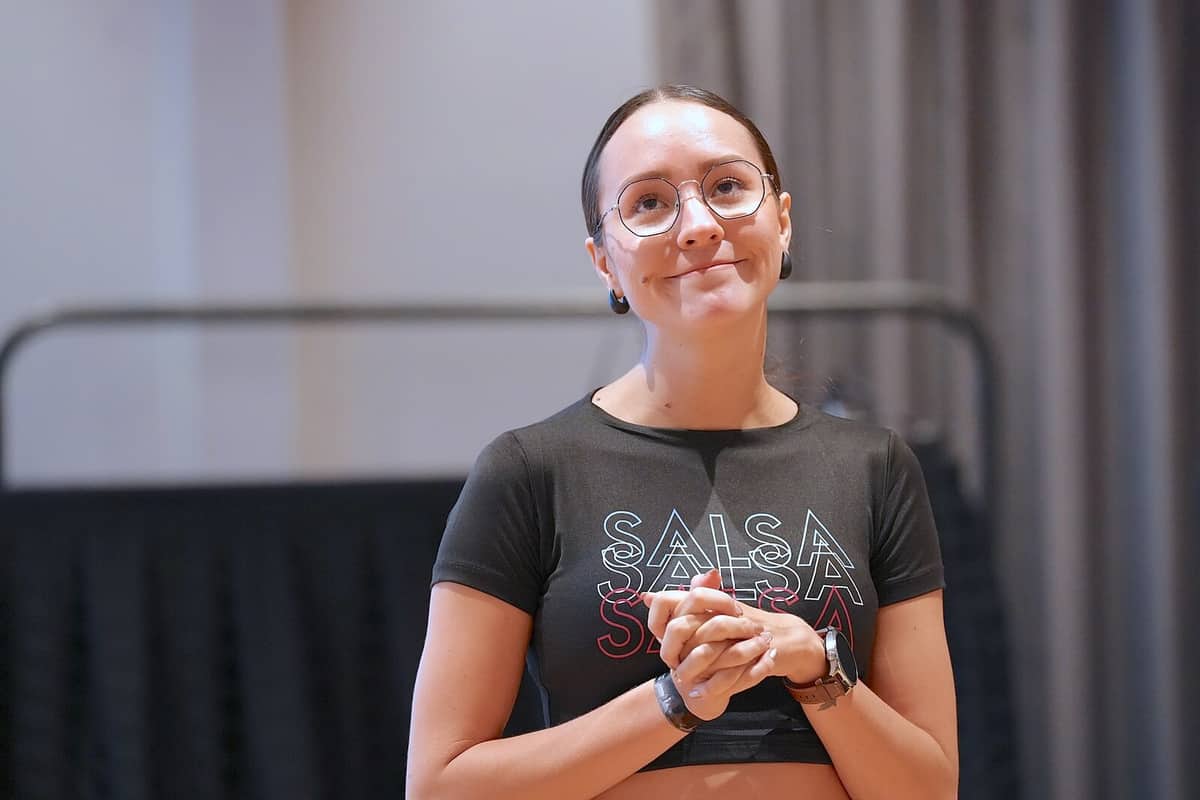
Photo: Rosiestep / CC BY-SA 4.0. Laura Herrera Aguirre performing solo at California Dance Festival 2025. Illustrative archive photograph; not a photograph of the current event or specific attraction discussed. Resized and JPEG-compressed.